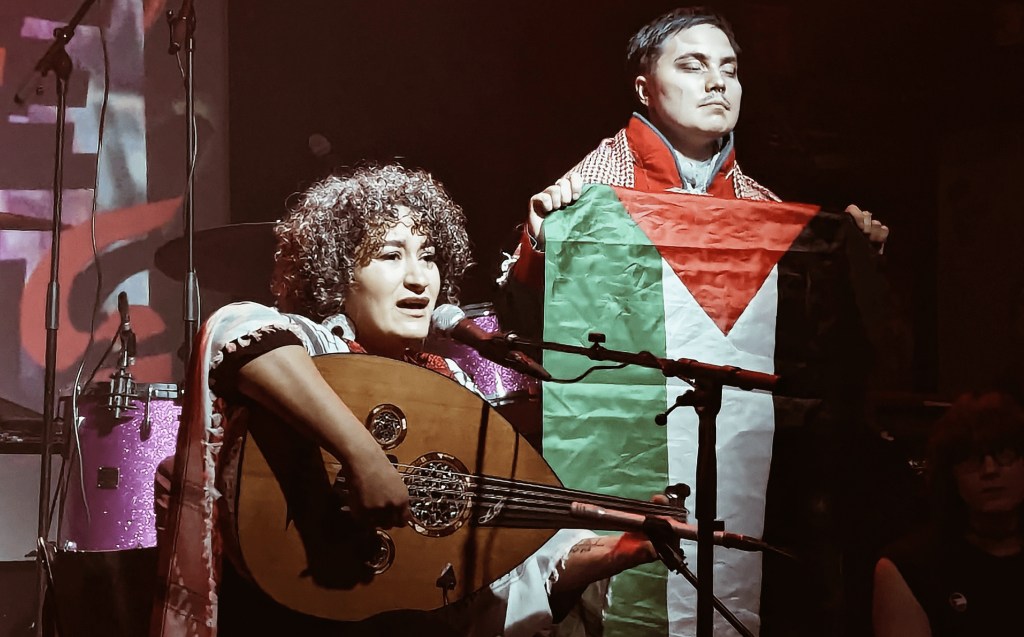
In the context of the horrific events in Gaza, the charity event Ilta Gazalle (Evening for Gaza) took place on 26 February at Club Tavastia in Helsinki. The concert was organised by the organisation Sumud (Suomen Palestiina-verkosto), which campaigns for Palestinian rights and speaks out against colonialism, apartheid and Israel’s occupation. A full musical programme was offered and the artists Jesse Markin, Maija Kauhanen, Verneri Pohjola, Olavi Uusivirta, Samuli Putro, Ramy Essam, Nemat Battah, Elsi Sloan, Knife Girl and Ritni Tears performed together on stage.
The event itself was monumental, emotional and extremely moving. We all felt the powerlessness and injustice. More than 3000 people were waiting outside the doors to be let in, so the evening didn’t start until 30 minutes late. Tavastia’s organiser said that „customers who don’t normally visit Tavastia are as well present“. Before the event started, music by Palestinian artists was played. The music by all artists can be accessed via this playlist: Ilta Gazelle – Playlist
Finnish-Palestinian actress and writer Noora Dadu and Finnish actress and director Sara Melleri were the hosts of the evening and started the event in a serious tone saying „It is unbelievable to be here today. It’s hard to watch and listen, but we want to watch and listen.“
Noora Dadu then recited the powerful poem „This Is Why We Dance“ from the poetry collection RIFQA by Mohammed El-Kurd. El-Kurd lived in East Jerusalem. When he was 11 years old, Israeli settlers forced his family out of their home and moved in to occupy the house. The poem centres the Gaza bombings in 2008 and deals with what it means to be Palestinian in the Western world.
My ritual of watching T.V / Ran between the grieving / And Egyptian belly dance music
If you ask me where I’m from it’s not a one-word answer
My father told me: „Anger is a luxury that we cannot afford“
The first act was Palestinian-Jordanian oud-player and singer Nemat Battah. She welcomed the audience with love and warmth and opened with a song called „A’la Taree’e Aytaat“. Lebanese musician William Nasser wrote the song for his friend Anuwar Yassiin who was a political prisoner in the Israeli Prisons for 19 years because he was involved in the liberation of Southern Lebanon from Israeli. The chorus recounts that the prisoner cried blood. The tune itself was repetitive in a meditative way. Everyone sang together by the last verse.
Jesse Markin came on stage and sang three songs full of light and ease. As a UMK artist he was the first and so far only artist to announce a boycott against Eurovision, should he be the winner of the Finnish pre-selection Uuden Musiikin Kilpailu. Sunshine is a song about wanting everything in the world, especially wealth, success and happiness. The second song was called Hope. It is an ode to the course of life, of the hard work which needs to be given in order to fulfil your dreams and the teachings of failures and mistakes.
After Jesse Markin’s gig followed Finnish musician Samuli Putro and Deanu river Sámi drag artist Ritni Tears. Together they performed Samuli Putro’s „Älkää unohtako toisianne“. Putro sang a-capella with a range of despair and hope about not forgetting each other in dark times while Ritni Tears was mimicking Putro’s vocal performance. The performance illustrated the relationship between heard and unheard voices and stressed the importance of remembering minorities and everyone else who feel unseen in the world. In a way the song tried to fight loneliness and desperation with full empathy. It reminded me of the fact that half of the population in Gaza are children and that those victims are not numbers, they are real people.
Not only music performances accompanied the event. Finnish actor Amanda Pallo came on stage and humorously announced an art work auction. Everyone laughed when she read the caption of her black t-shirt out loud: „I don’t need sex, the government fucks me every day“. The earnings of the auction will be donated to the organisation Sumud and Medical Aid for Palestinians (MAP).
In between acts Palestinian artists appeared on the screen by showcasing music videos or video greetings as a way to thank the public for the donation and care.
Most intriguing was Jowan Safadi’s lyric video I am the Semite which reminded the viewer that Palestinians and Israeli people derive from the same Semitic culture. The Palestinian musician refers as well to genetical studies which reveal the similarity between Palestinian and Israeli genes. The song is sung in a cold voice illustrating the powerlessness and poverty that Palestinians are faced with every day.
I am a Semite like you used to be
I’m the Semite that no one wants to see
I call you out on your crimes
You call me anti-Semite
And flip the reality
Another captivating music video was Yusor Hamed x Maysa Daw’s Tuffah. Yusor Hamed is a Palestinian singer, songwriter and producer who fuses Northern African rhythms with Swedish electronic dance music. Tuffah illustrates the „longing for the day when the land between the Jordan River and the Mediterranean Sea is no longer fragmented.“ Bird wings are used as a fan, the ocean drum is played according to the beat of the kick-drum as if to conduct a ritual. Flowers are laid before an animal skull as a way to pay respects of the ancestors and mourn the past.
Finnish trumpet Verneri Pohjola is best known for his collaboration with composer Kaija Saariaho who dedicated the concert „Hush“ to him. Pohjola appeared with his trumpet and pedals and created a grueling and desperate atmosphere. The loops consisted of a long melody line which were followed by crooked cries as if people were crying in panic. The fading of the piece by the end created a hopeful note like white doves flying into heaven.
Another mesmerizing moment was Ramy Essam’s presence with his band. Essam narrated a story where illiterate people created a letter and protested in front of a UN embassy to stand for their rights. Politicians may not be able to consider and understand the living conditions of all people. What struck me the most from the story was the line: „I am silent, but that doesn’t mean I am weak.“ Next Essam performed John Lennon’s „I Don’t Wanna Be a Soldier Mama I Don’t Wanna Die“ which depicts the horror of soldiers who are confronted with war and violence. It was impressive to observe the energetic, passionate stage presence of the Egyptian rocker.
By the end of the evening, all performers arrived on stage and sang together with Oud-player Nemat Battah „Biktub Ismik Ya Bladi“. It is written by Lebanese musician Elie Shweiri and starts with the following lines (translated in English):
I will write your name oh my country, above the sun that never sets.
Not my children nor my wealth, above your love there is no love.
According to Battah, the song resembles „our connection with our land, the hopes of returning, reuniting and celebrating together“.
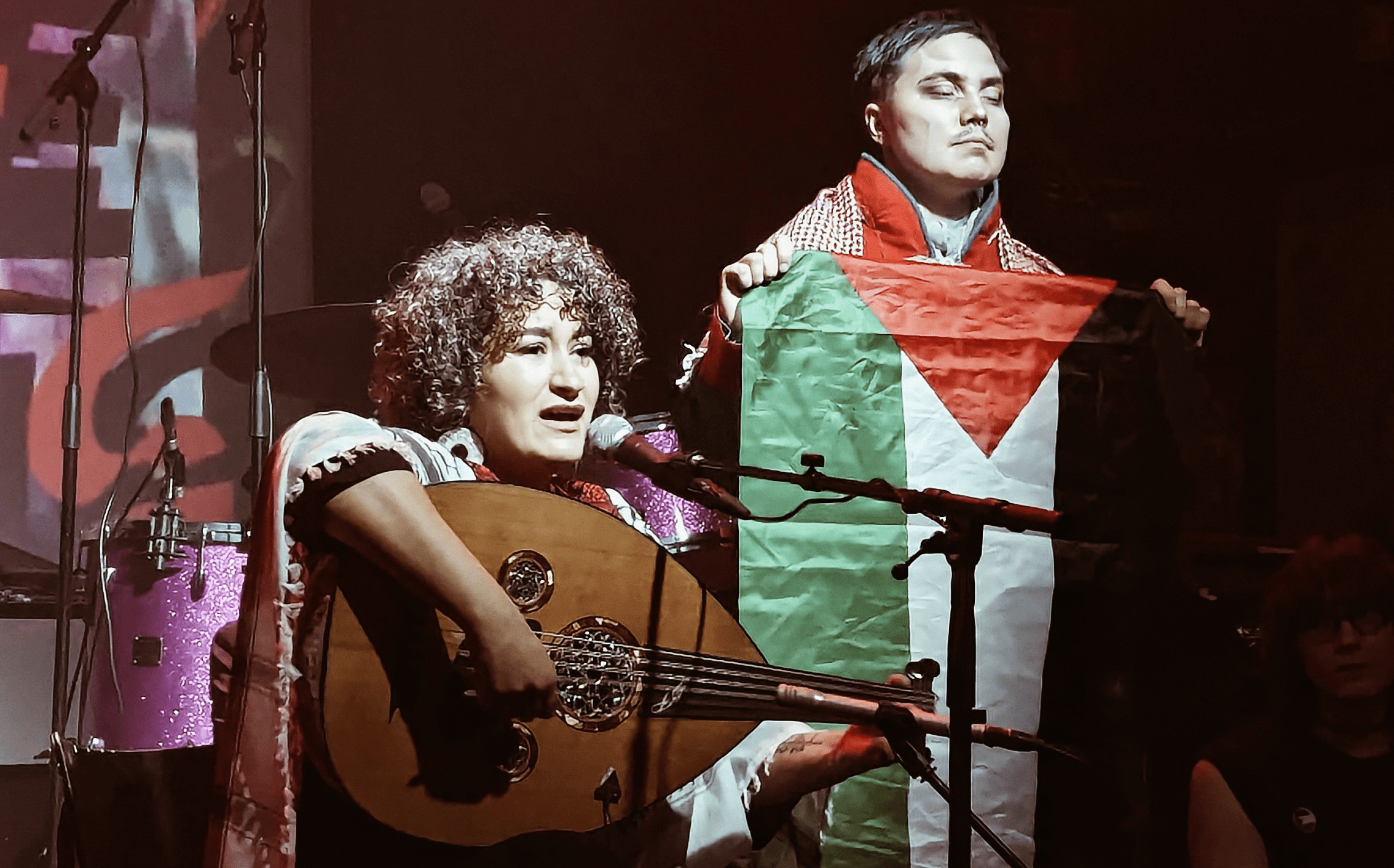
Picture: Nemat Battah with Ritni Tears. Source: Lara Tahm
The public can support organisations like Boycott, Divestment and Sanctions (BDS), Finland Against Apartheid, Sumud and Medical Aid for Palestinians (MAP). The hosts also reminded the audience that other people from other countries are occupied by war and violence, like Syria, Ukraine, South Sudan, Myanmar and Ethiopia.
Silence is not a normal state. Silence is a privilege.
Sources:
Austin, Alice (13.04.2024), „Yusor Hamed is redrawing the boundaries of Palestinian sound“, in: +972 Magazine, https://www.972mag.com/yusor-hamed-palestinian-musician/ (18.04.2024)
„Ilta Gazalle, in: Tavastia Klibu“ https://tavastiaklubi.fi/events/2024-02-26/ilta-gazalle/97561/ (18.04.2024)
„10 Conflicts to Watch in 2024“ (01.01.2024), in: International Crisis Group (24.03.2024), https://www.crisisgroup.org/global/10-conflicts-watch-2024 (24.04.2024)
„Biktub Ismak Ya Biladi – Yes we told them, we do know what it means“ https://peacenews.info/node/8829/biktub-ismak-ya-biladi (24.04.2024)
 laratahm
Hinterlasse einen Kommentar